OTAR® Track Record: Proven Internationally, Delivered in Indonesia
25+ Years of Ammonia Recovery Performance
OTAR® has been removing and recovering ammonia from high-strength wastewater since 1998, with installations across Hong Kong, the UK and Australia treating landfill leachate, industrial effluent and digester side-streams. This page presents that verified international track record, and explains how Organics Bali brings the same platform (adapted to Indonesian regulatory requirements) to palm oil, food and beverage, livestock and municipal wastewater applications across Indonesia.
Indonesia’s Ammonia Treatment Challenge
Ammonia discharge in Indonesia is regulated through a layered framework. PP No. 22/2021 sets the national environmental protection framework; Permen LHK No. P.68/2016 governs domestic wastewater; Permen LH No. 5/2014 (as amended by P.21/2018) sets sector-specific industrial effluent standards; and provincial regulations — such as Pergub Bali No. 16/2016, which caps ammonia in domestic wastewater at 10 mg/L — can set stricter local limits. The applicable limit for any given facility depends on its sector, location, and environmental permit (izin lingkungan / persetujuan teknis).
High-ammonia streams are common across several Indonesian industries: landfill leachate (TPA) frequently exceeds 4,000–6,700 mg/L NH3-N; palm oil mill effluent (POME) carries high ammonia-nitrogen alongside heavy BOD/COD loads; tofu and tempeh (tahu/tempe) processing — a significant small-to-medium industry sector across Java — generates protein-rich wastewater with elevated ammonia; and livestock wastewater from cattle, pig and poultry operations concentrates ammoniacal nitrogen from manure and washdown water.
OTAR® Solution Overview
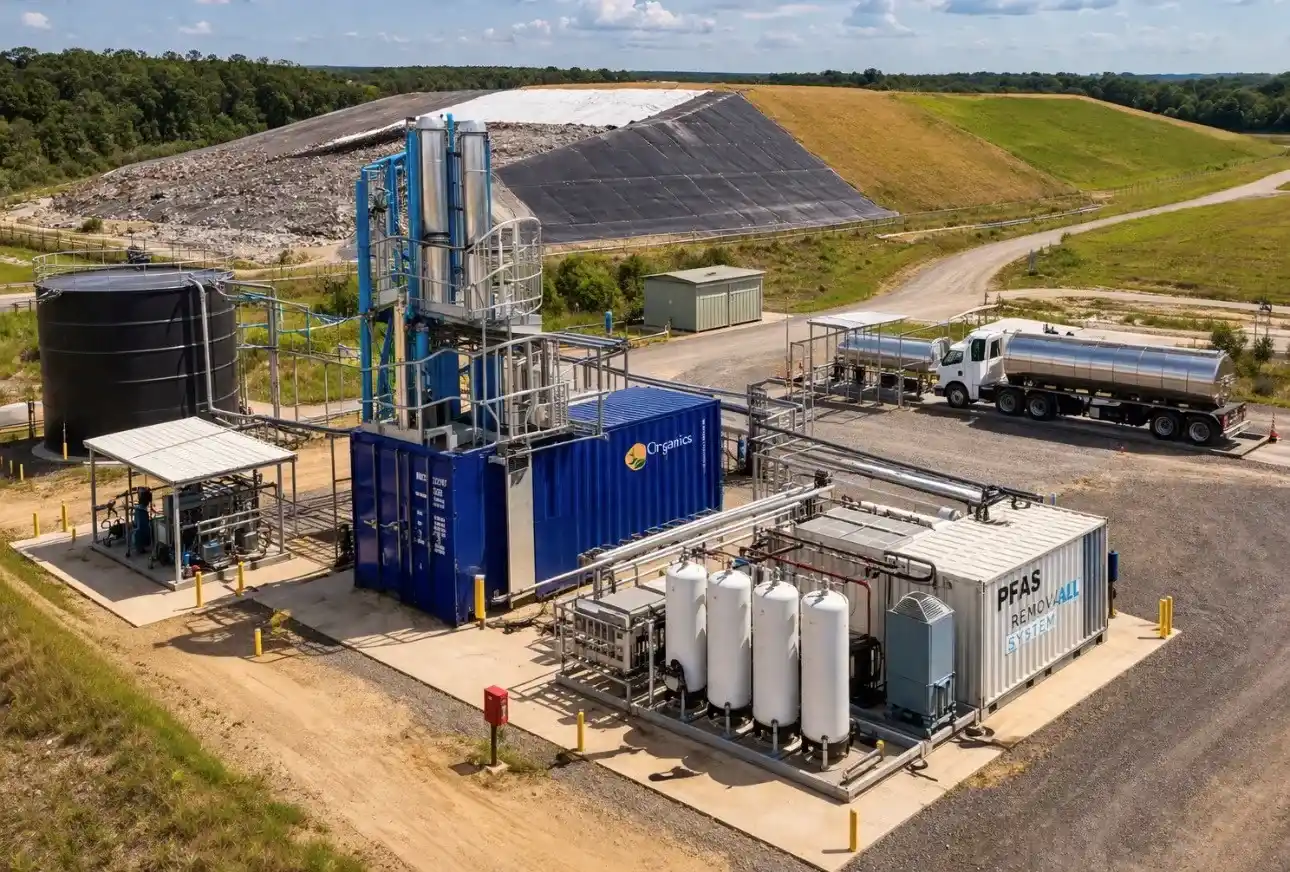
The OTAR® is a thermally-driven, non-biological ammonia stripping and recovery platform. Because it physically strips ammonia from the liquid phase using heat — or pH adjustment where waste heat is limited — rather than relying on a living microbial culture, it is more predictable under shock loads and protects downstream biological reactors from ammonia toxicity. With a polishing stage, OTAR® can achieve effluent concentrations below 100 mg/L NH3-N even from influent as high as 6,700 mg/L.
OTAR® is suitable for:
- Landfill leachate (TPA) — high ammonia, variable flow, seasonal peaks
- AD / biogas centrate — concentrated dewatering liquor that would otherwise recirculate ammonia to the head of the works
- Palm oil & food industrial wastewater — protein-heavy, high-BOD streams (POME, tahu/tempe, fisheries processing)
- Livestock wastewater — cattle, pig and poultry manure and washdown wate
OTAR® in Indonesia: Global Track Record, Local Delivery
Organics Bali is not yet operating a commissioned OTAR® installation in Indonesia. What Organics Bali offers is direct access to a platform with more than 25 years of proven, documented performance internationally — delivered locally through PT Organics Bali (Jakarta) and PT Organicsindo Konstruksi Energi (Bandung), with the same engineering standards used on the Hong Kong and international installations referenced below.
For Indonesian facilities, that means the opportunity to be among the first to bring a proven ammonia recovery platform into the local market — backed by a track record built on real, high-strength wastewater conditions (up to 6,700 mg/L NH3-N), not a pilot scale.
Every OTAR® project delivered in Indonesia is engineered against the country’s applicable regulatory framework — PP No. 22/2021, Permen LHK P.68/2016, sector-specific standards under Permen LH No. 5/2014, and relevant provincial limits — from feasibility through EPC delivery.
International Track Record: West New Territories (WENT) Landfill, Hong Kong
Challenge
The Hong Kong Environmental Protection Department required a reliable, long-term solution for treating landfill leachate carrying ammonia-nitrogen concentrations as high as 6,700 mg/L — far beyond what conventional biological treatment could handle without pre-treatment, and requiring compliance with stringent nitrogen discharge limits across multiple expansion phases of the same site.
Solution
Organics delivered an OTAR® Variant 1 (waste heat with thermal destruction) configuration, drawing waste heat from nearby landfill gas and biogas engines to strip ammonia from the leachate and destroy it thermally — with no downstream chemical handling required. The system has been expanded across multiple lines at the site as leachate volumes have grown.


Project Specifications & Performance
| Location | West New Territories (WENT) Landfill, Hong Kong |
|---|---|
| Client | Hong Kong Environmental Protection Department |
| Configuration | OTAR® Variant 1 — waste heat with thermal destruction |
| Design Flow Rate | 1,000–2,300 m³/day across expansion lines |
| Influent Ammonia Concentration | Up to 6,700 mg/L NH3-N |
| Primary Outcome | Consistently <100 mg/L NH3-N; compliant with stringent nitrogen discharge limits across multiple expansion lines |
Why This Project Matters
- Durability — expanded across multiple lines at the same site over more than two decades, demonstrating sustained performance rather than a single pilot installation.
- Scale — one of the highest documented influent ammonia concentrations in Organics’ portfolio (6,700 mg/L), treated consistently to under 100 mg/L.
- Low OPEX — runs on waste heat from landfill gas and biogas engines already on site, with no downstream chemical handling required.
OTAR® Other Reference Project
Hong Kong, South East New Territories
This OTAR® installation treats concentrated landfill leachate with influent ammonia levels in the range of 4,000–6,000 mg/L and variable daily flows. By removing ammonia upstream of biological treatment, the system reduced shock loading risk and improved overall process reliability under fluctuating operating conditions.
United Kingdom, Northumbrian Water
OTAR® was applied to municipal sidestream treatment, processing return liquors with ammonia concentrations of approximately 3,500–5,000 mg/L at flows of 50–300 m³/day. The system protected biological reactors from ammonia shock load while supporting stable nitrification performance across the main treatment works.
Hong Kong – Line 2North East New Territories
This project treats high-ammonia landfill leachate with influent concentrations typically between 4,500–6,500 mg/L, at feed flows of up to 1,000 m³/day. OTAR® maintained robust performance despite variable loading, supporting regulatory compliance and downstream biological process protection.
Hong Kong, O·Park 1 (Organic Waste Treatment Facility)
At O·Park 1, OTAR® manages ammonia-rich process liquors generated from large-scale organic waste treatment and anaerobic digestion. Treating streams with ammonia concentrations of 3,000–5,000 mg/L, the system supports stable operation of the integrated waste-to-energy facility while maintaining compliance with discharge requirements.
Australia, OTAR® Thermal Ammonia Recovery
Commissioned March 2002 at a design flow of 12.5 m³/hr and influent ammonia of 1,875 mg/L NH3/NH4. Reduced ammonia to compliant discharge levels, protecting downstream biological assets and avoiding EPA penalties — now in its third decade of continuous operation.
Why OTAR® ?
Cost efficiency
- Runs on waste heat instead of continuous chemical dosing (lime, caustic, sulphuric acid).
- Lower cost per kg-N removed than biological nitrification–denitrification (BNR) or Anammox, per Organics Group project benchmarking.
- Avoids N2O emissions associated with biological nitrogen removal, reducing carbon-cost exposure.
Compliance & Resource Recovery Value
- Achieves effluent concentrations that support compliance with PP No. 22/2021, Permen LHK P.68/2016, and sector-specific standards under Permen LH No. 5/2014.
- Recovered ammonia can be converted to ammonium sulphate — a fertiliser input with direct relevance to Indonesia’s agriculture sector — turning a compliance cost into a partially offsetting product stream.
- Reduces the ammonia load reaching biological treatment, protecting nitrification capacity and, where relevant, anaerobic digestion / biogas performance.
Why OTAR® ?
Cost efficiency
- Runs on waste heat instead of continuous chemical dosing (lime, caustic, sulphuric acid).
- Lower cost per kg-N removed than biological nitrification–denitrification (BNR) or Anammox, per Organics Group project benchmarking.
- Avoids N2O emissions associated with biological nitrogen removal, reducing carbon-cost exposure.
Compliance & Resource Recovery Value
- Achieves effluent concentrations that support compliance with PP No. 22/2021, Permen LHK P.68/2016, and sector-specific standards under Permen LH No. 5/2014.
- Recovered ammonia can be converted to ammonium sulphate — a fertiliser input with direct relevance to Indonesia’s agriculture sector — turning a compliance cost into a partially offsetting product stream.
- Reduces the ammonia load reaching biological treatment, protecting nitrification capacity and, where relevant, anaerobic digestion / biogas performance.
What More Could Your Wastewater Deliver?
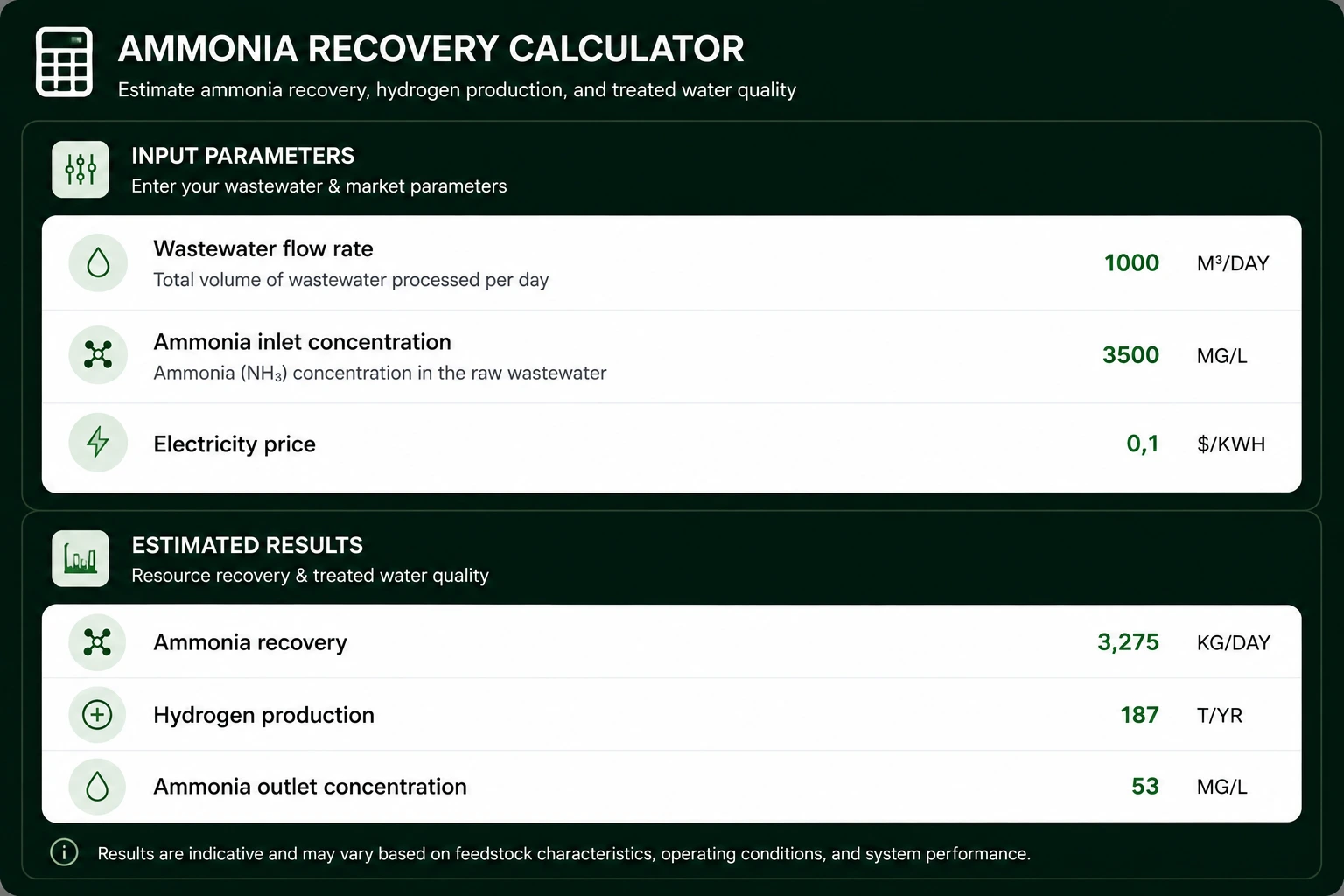
Evaluate the potential to recover ammonia and produce hydrogen while understanding the energy requirements and economics of your wastewater treatment process.
Free • Preliminary Estimate • No Commitment